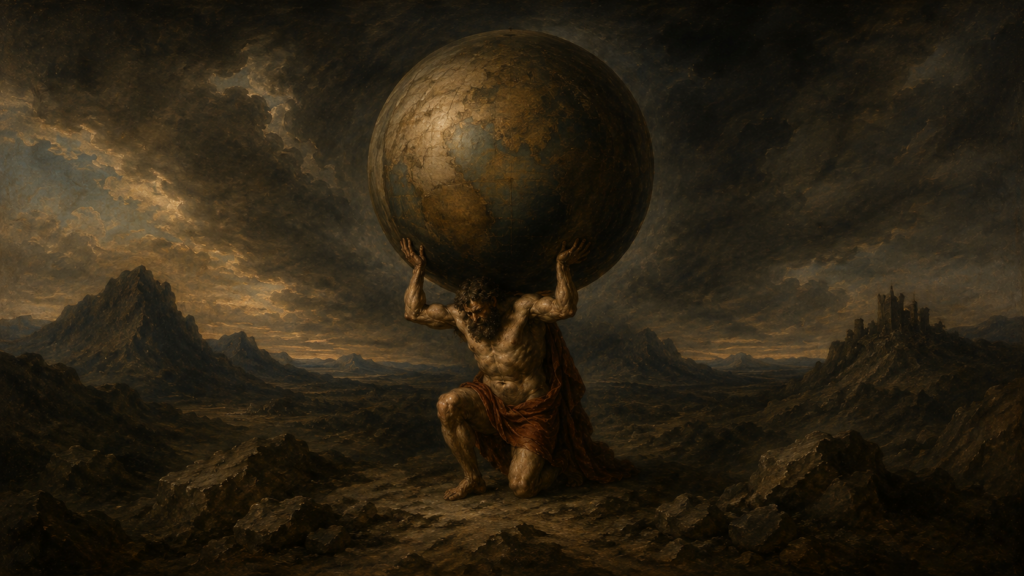
There is a moment most of us know well. The moment when everything has been building for so long, the grief, the disappointment, the unanswered prayers, the people who keep letting us down, and then something small happens. Something almost insignificant. And we snap.
It happens to the best of us. It even happened to Moses.
Two Men, Two Moments, Two Outcomes
Centuries apart, two figures in scripture faced eerily similar circumstances. Both were under enormous pressure. Both were emotionally exhausted. Both were surrounded by people who failed to understand what they were carrying. And yet, their responses could not have been more different, and neither could their outcomes.
The first is Moses, recorded in Numbers 20. Before we rush to judge him, we need to understand what he was carrying in that moment. His sister Miriam had just died. She was not only his family but a pillar of leadership among the Israelites. He was deep in grief. And rather than being given space to mourn, the people of Israel gathered around him and attacked him. They were thirsty. They needed water. And in their desperation, they turned on their leader.
This was not the first time. It was the sixth recorded instance of the Israelites contending with Moses. For nearly 40 years, he had absorbed their complaints, their rebellions, their accusations, and their fear. He had carried the weight of a nation that grumbled about food even while receiving daily provision, that saw the bounty of the promised land and still chose to focus on the obstacles, that mutinied against his leadership even after witnessing miracle after miracle.
When God instructed Moses to speak to the rock so that water would flow, Moses instead struck it. Twice. In anger. In bitterness. In the overflow of decades of unprocessed pain.
Water still flowed. The miracle still happened. But Moses was barred from entering the promised land. He saw it from a distance. He never stepped into it.
Fast forward to the Garden of Gethsemane in Matthew 26. Jesus, knowing exactly what awaited him, fell on his face before the Father and prayed. The weight he carried was incomprehensible. Yet his response was not bitterness. It was surrender. “Not as I will, but as you will.” When the mob arrived to arrest him and Peter drew his sword in offense, Jesus did not validate the anger. He told Peter to put the sword away, and then he healed the very man who had come to take him away.
Same pressure. Completely different response. Completely different outcome.
The Rock and the Cross
There is a profound parallel woven through both accounts that is worth sitting with. When Moses struck the rock in the wilderness, water flowed even though the people were faithless and grumbling. When Jesus was struck on the cross, blood and water flowed even though the crowd mocked him and rejected him.
In both moments, God’s provision was not conditional on human perfection or belief. It was conditional entirely on his character. His grace poured out anyway.
But here is the critical truth: while God’s character determines the release of his provision, our actions determine whether we partake in it. The Israelites received water from the rock, but an entire generation died in the desert and never entered the promised land. Moses witnessed the miracle but missed his destiny. The miracle happened. He just was not in it.
This is the difference between salvation and inheritance. Salvation is the free gift, the rescue from bondage, the guarantee of belonging to God’s family. But inheritance is what belongs to us because we are children of the King. It is kingdom territory, spiritual authority, covenant promises, the fullness of what God has prepared for those who walk in alignment with him. Many of us receive salvation and stop there, never realising there is so much more to step into.
What the Wilderness Does to an Unguarded Heart
The wilderness is not always a desert. It is any season of intense pressure that stirs deep emotion. Grief. Financial strain. Broken relationships. Prolonged waiting. Unanswered prayers. The wilderness is whatever is pressing in on you right now.
And when we do not guard our hearts in the wilderness, three things become vulnerable.
Our speech is the first casualty. Out of the overflow of the heart, the mouth speaks. When our hearts are filled with offense and bitterness, our words begin to reflect the obstacle rather than the promise.
Our sight is next. An unguarded heart blinds us. Moses looked at the rock and saw only an obstacle. He could not see the grace God wanted to display. Jesus, even through blood and tears, looked at the crowd and saw a harvest. He kept his eyes on the joy set before him.
Finally, our steps become corrupted. It was not Moses’ anger that cost him the promised land. It was his action. He struck when God said speak. Disobedience, born out of unguarded emotion, redirected his feet away from his destiny.
The Survival Guide Jesus Left Us
Jesus did not leave us without direction for navigating the wilderness. In Matthew 6, he gave us a prayer that functions as a tactical guide for guarding the heart under pressure.
“Our Father, who art in heaven” shifts our focus from the obstacle to the source. “Your kingdom come, your will be done” realigns us, stopping the demand for our own timelines. “Give us this day our daily bread” trains us to depend on progressive, daily provision rather than panic. “Forgive us our debts as we forgive our debtors” empties us of the offenses we have been collecting. “Lead us not into temptation” sets a guard over our emotions when we are at our most vulnerable. “For thine is the kingdom, the power, and the glory” declares that the breakthrough does not belong to us. It belongs to him.
Do Not Strike the Rock
The invitation today is simple but weighty. Do not make the mistake of Moses. Do not let the accumulated weight of the wilderness, the grief, the disappointment, the people who have failed you, the years of waiting, cause you to strike when God is saying speak.
The provision is already guaranteed by God’s character. The water is already there. The question is whether we will be unoffended enough to drink from it, pure enough to step through the door, and obedient enough to walk into the inheritance that has been prepared for us.
Drop the sword. Empty the offense. Align your steps with grace. The promised land is closer than you think.